I’ve sat in more discovery calls than I can count where a business owner opens with some version of the same line: “We’re doing everything right, but the leads just aren’t coming in.”
They’ve got a website. They’re posting on social media. Maybe they’ve even thrown some money at ads. And yet the phone isn’t ringing, the contact form is collecting dust, and the inbox is embarrassingly quiet.
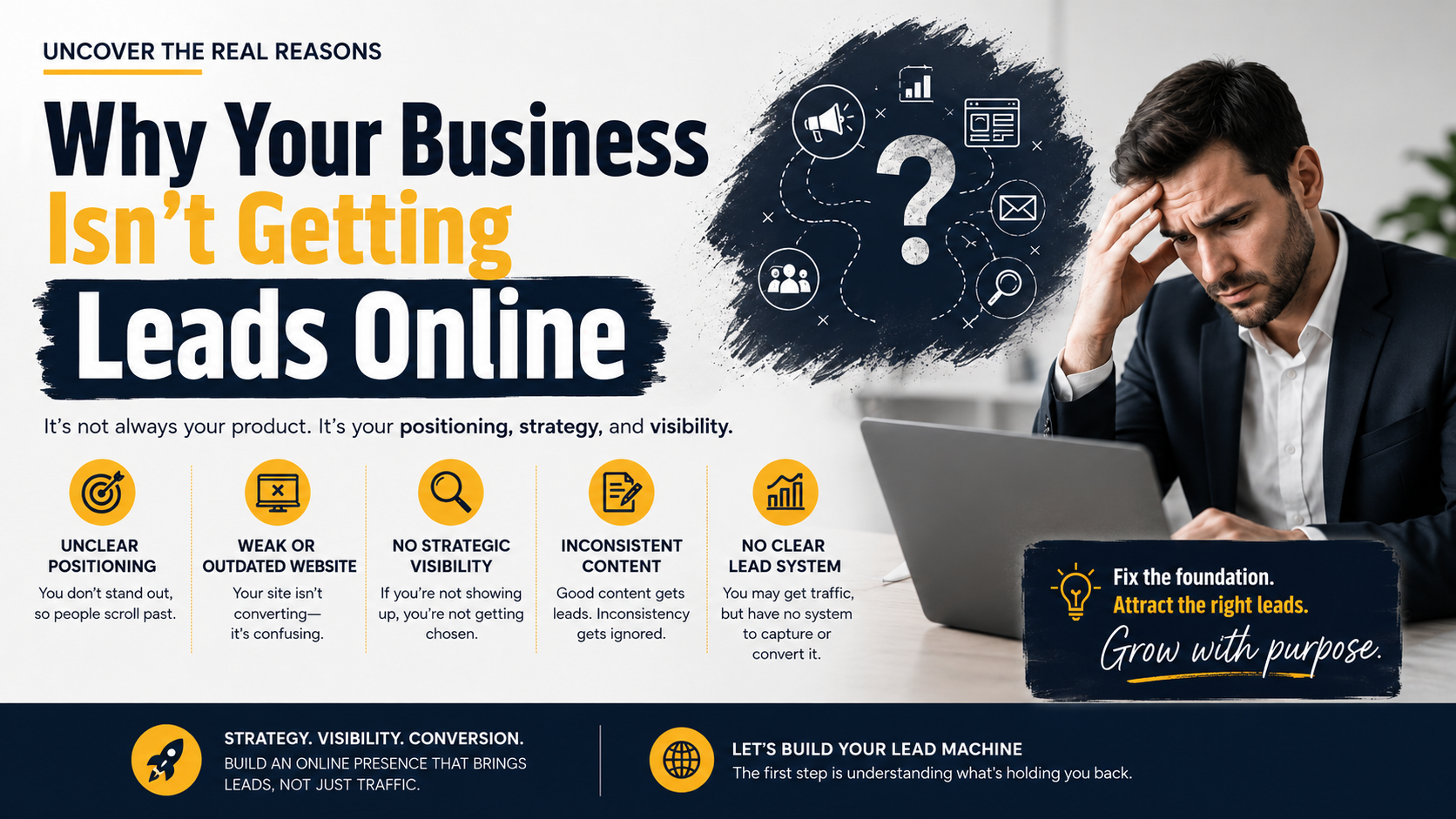
Here’s the uncomfortable truth I’ve learned after years of untangling this exact problem for clients: it’s rarely one big thing. It’s usually five or six small things quietly working against you at the same time. And most of them have nothing to do with “not doing enough marketing.”
Let’s actually dig into what’s going on.
Your Website Looks Fine. It Just Doesn’t Work.
This one stings a little, so bear with me.
A lot of business owners judge their websites the way they’d judge a business card. Does it look professional, is the logo centered, are the colors on-brand? But a website isn’t a business card. It’s a salesperson that never sleeps, and right now, yours is probably standing at the door mumbling.
Think about the last time you landed on a site and left within five seconds. What made you bounce? Usually it’s one of these:
- You couldn’t tell what the business actually does, fast enough
- There was no clear next step no obvious button telling you what to do
- It took forever to load, especially on a phone
- It read like it was written for a search engine, not a human being
If a stranger can’t figure out what you do and why they should care within about ten seconds, they’re gone. Doesn’t matter how good your service is. They’ll never find out.
You’re Attracting Traffic, Not People Who Want to Buy
This is the one nobody wants to hear, especially after spending money on ads.
Getting visitors to your site isn’t the same as getting the right visitors. I’ve worked with businesses that were proud of their traffic numbers, thousands of visits a month, but their close rate was near zero. Why? Because the traffic was made up of people who weren’t remotely close to being customers. Students researching for a school project. Competitors scoping things out. People in a completely different city who stumbled in through a badly targeted ad.
Real lead generation isn’t a numbers game in the way people assume. It’s not “get as many eyeballs as possible. ” It’s “get the eyeballs that actually belong to someone with the problem you solve, the budget to fix it, and the intent to act soon.”
A smaller, sharper audience will outperform a big vague one every single time.
Nobody Trusts You Yet And You Haven’t Given Them a Reason To
Put yourself in your customer’s shoes for a second. They don’t know you. They’ve probably been burned before by a business that overpromised. So before they hand over their email, their phone number, or their money, they’re quietly asking themselves, “Can I trust this company?”
Most websites answer that question with silence. No reviews visible. No real photos of the team or the work. No case studies. Just stock images and vague claims like “quality service you can count on” which, respectfully, could be copy-pasted onto literally any competitor’s site and nobody would notice.
Trust isn’t built with claims. It’s built with proof. Specific numbers. Before-and-afters. Client names, if you can get them. A face, a voice, a story. The businesses that win online aren’t always the best at what they do; they’re often just the ones who did a better job proving it.
You’re Chasing New Tactics Instead of Fixing the Foundation
Every few months there’s a new shiny thing. TikTok is the answer. No wait, it’s AI chatbots. No, actually, it’s this one weird trick with Google ads.
Meanwhile, the fundamentals sit untouched; the messaging is still confusing, the follow-up process is nonexistent, and leads that do come in take three days to get a response (if they get one at all).
Chasing tactics without fixing the foundation is like adding a second engine to a car with a flat tire. It’s not going to move faster. If anything, it’s going to break down in a more expensive way.
Before adding anything new, it’s worth asking a harder question: of the people who already showed interest, who filled out the form, who called, and who messaged on Instagram, how many of them actually got a fast, human, useful response? For a lot of businesses, that number is uncomfortably low. And that leak is costing more than any new tactic could ever recover.
You’re Talking About Yourself. They’re Wondering About Themselves.
This is subtle, but it might be the biggest one.
Look at your homepage, your ads, and your social captions. Count how many times they say “we.” We’ve been in business for 15 years. We pride ourselves on quality. We offer the best service in town.
Now think about what your customer actually cares about in that moment. It’s not you. It’s their problem. Their deadline. Their budget. Their fear of hiring the wrong person again.
The businesses that generate leads consistently have simply gotten good at flipping the lens, talking less about themselves and more about the person on the other side of the screen. Not in a manipulative way. Just in a “we see you, we get it, here’s how this actually helps you” way.
It’s a small shift in language that changes everything about how a page feels to read.
So What Actually Fixes This?
There’s no single silver bullet, and honestly, anyone who tells you there is one is selling you something. But if I had to boil down what actually moves the needle for the businesses we work with, it comes down to this order of operations:
- Get brutally clear on who you’re talking to. Not “everyone who needs our service.” A specific person, with a specific problem, at a specific moment of urgency.
- Fix the first ten seconds. Whatever page someone lands on first, make sure it answers “what is this, and why should I care” instantly.
- Show, don’t tell, for trust. Real proof beats polished claims every time.
- Tighten the follow-up. A slower competitor with a faster response time will beat you almost every time.
- Then, and only then, add more traffic. Pouring more visitors into a leaky system just means more people watching you drop the ball.
Getting leads online was never really about doing more. It’s about removing the friction that’s quietly pushing people away before they ever reach out. Fix that, and you’ll notice something interesting you don’t need nearly as much traffic as you thought you did to keep your pipeline full.